

Welcome to WordPress. This is your first post. Edit or delete it, then start writing!
Blog
-
Gerry ‘the Monk’ Hutch Challenges Gangsters Inc.
At their inauguration, public leaders
must swear to uphold unwritten law and weep
to atone for their presumption to hold office –
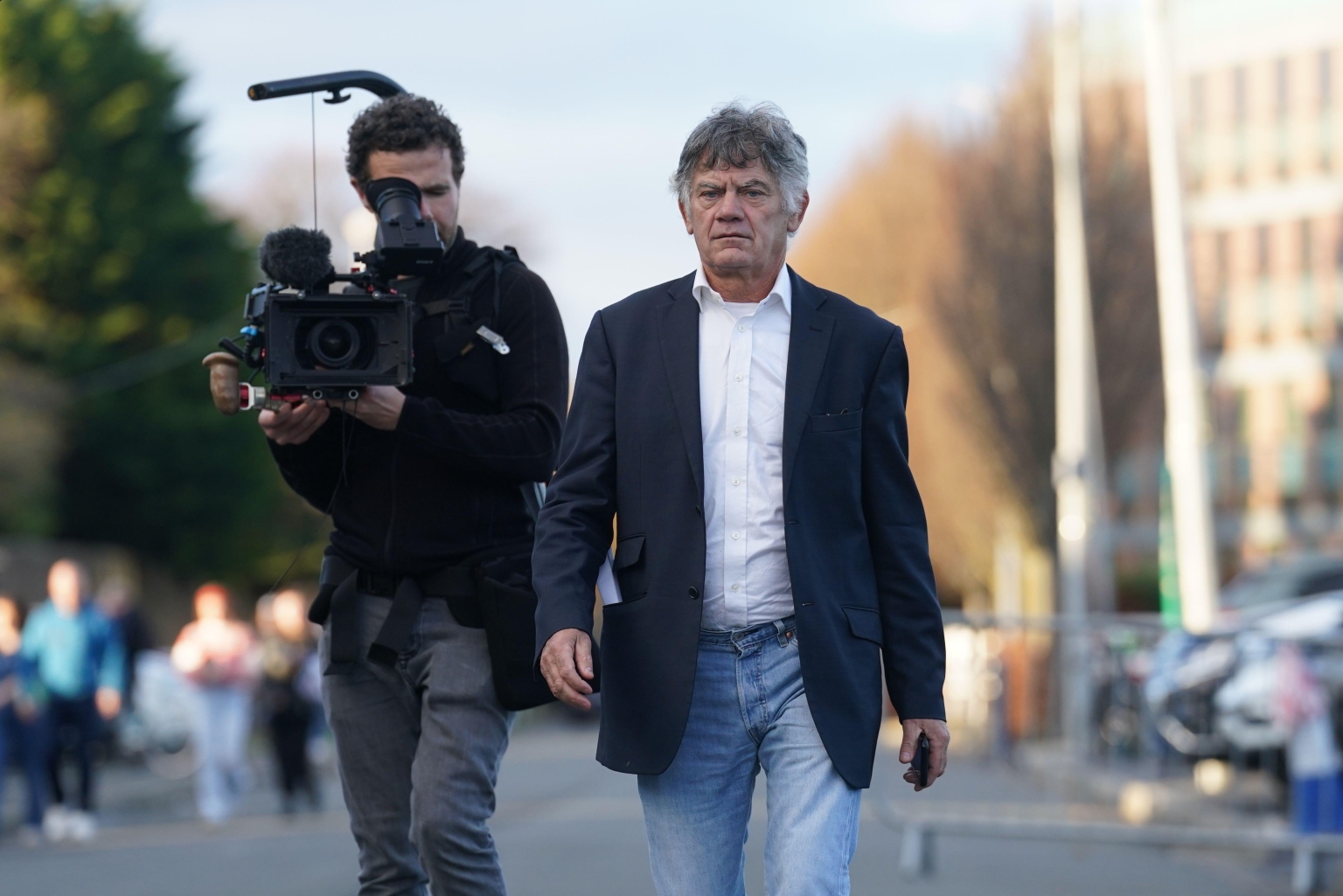
Seamus Heaney, ‘From the Republic of Conscience’With a Dublin Central by-election on the horizon, Irish politics appears to be descending into GUBU. The ‘grotesque, unbelievable, bizarre and unprecedented’ prospect of alleged crime boss Gerry ‘the Monk’ Hutch taking a seat in Dáil Éireann looms large in a May by-election triggered by the resignation of former Finance Minister Paschal Donohoe.
Supreme Court Justice Peter Charleton once inquired as to why I pleaded for John Gilligan not as a gentleman, but as a self-employed businessman. Gilligan’s singular presence and the shadow over the murder of Veronica Guerin engendered the Criminal Assets Bureau and The Proceeds of Crime Act 1996. This was the beginning of the end for Due Process in Ireland. In the interim, one form of organised crime mutated into another via NAMA and offshore accounts. Thus, Ireland’s Gangster Inc. of Cuckoo and Vulture Funds was born.
Of course, Gilligan never held political office, but Hutch’s candidacy and near election to the Dáil in 2023 begs the question as to whether an alleged crime boss ought to be barred from holding political office. Any such prohibition would raise questions of definition, and indeed whether the activities of present or former office holders, including at least one former Minister for Justice I can think of, might fit that description.
There are obvious examples of corrupt politicians such as former Fianna Fáil T.D. Liam Lawlor, paid a small fortune by Beef Baron Larry Goodman, who remains one of the state’s richest citizens. During the 1980s a rogue’s gallery of grafters made their home in Leinster House. Today’s white collar criminals keep their finger nails clean, if not their toe nails, which remain firmly embedded in the dirt.

A drawing of Ned Kelly on a wall in Melbourne. Art Imitating Life?
A hagiographic play recently staged in Dublin’s Ambassador Theatre offered an alternative take on the staid format of the party-political broadcast. Remarkably, the eponymous hero of ‘The Monk’ made a surprise appearance on stage on the opening night, taking part in a fictional live question-and-answer session with playwright and performer Rex Ryan.
The lineage of conventional – as opposed to de facto – Irish gangsters proceeds from Martin Cahill to Gilligan and the Kinahan Cartel, and on to Gerry Hutch. The Irish media display a morbid fascination mixed with veneration for their undeniable chutzpah – Martin Cahill’s costume clown appearances on multiple court appearances springs to mind.
It is certainly not an exclusively Irish phenomenon. In his autobiography, Geoffrey Robertson KC describes his fellow Australian’s veneration of the Wild Colonial Boy, Ned Kelly. Further evidence emanates from the global success of Francis Ford Coppola’s The Godfather (1970), or the many films of Martin Scorsese exploring mobsters’ lives.
It should be acknowledged that politics has always had close associations with crime, and not just in a state such as Italy under Andreotti or Berlusconi. The distribution of patronage and the promulgation of laws are often to the benefit of sectional, corporate or individual interests, who endeavour, and often grease, political machines with filthy lucre.
A dirty business requires forensic and independent journalism, and may even compromise those intent on cleaning it up. JFK’s brother Bobby went full throttle against organised crime post-election, but the former seems to have relied on shady elements to win the Presidential election. That unrequited love may have led, one way or another, to Dallas, Texas.
As Boby Dylan put it in ‘Murder Most Foul’:
Then they blew off his head when he was still in the car
Shot down like a dog in broad daylight
‘Twas a matter of timing and the timing was right
You got unpaid debts and we’ve come to collect
We’re gon’ kill you with hatred and without any respect
We’ll mock you and shock you, we’ll grin in your face
We’ve already got someone here to take your place…
That’s the place where Faith, Hope and Charity died
That infamous day certainly paved the way for the cabal now in office: ‘Business is business and it’s murder most foul.’
Terrorist to Law-Maker?
A criminal and law-breaker, or even a terrorist, can also become a unifying figure like Nelson Mandela, a national hero such as Michael Collins, or more ambiguously, a peacemaker like Gerry Adams. Perhaps Gerry Hutch is on his own Road to Damascus. He certainly portrays himself as a latter-day Robin Hood, bent on exposing the criminality of Garda Síochána. Who knows what he’d come out with under Dáil privilege. If so what could he achieve?
Gary Gannon, the pearl-clutching Social Democrats T.D. from the same constituency claimed to have been shocked at seeing Hutch on the ballot paper last time out. Former Taoiseach, and legendary recipient of brown envelopes, Bertie Ahern described Gannon’s comments as ‘absolute nonsense,’ and noted with moral ambivalence and some subtlety:
Gerry Hutch has been around as long as me. I won’t get into morals or ethics but I have trampled that ground for 40 years and Hutch has been kind to the community in Dublin Central in indirect ways. Whether we like it or not, he is respected by people which explains his 3,000 votes. It is not just younger people voting for him, older people I know voted for him. We can all say the self-righteous things we want but the reaction is what it is.
It is noteworthy that Ahern’s political machine was colloquially known as the Drumcondra Mafia. At least when Hutch was growing up in the area, there were few options other than criminality for raising oneself out of poverty. Moreover, as Balzac put it: ‘Behind every great fortune there is a crime’ Which among the wealthiest individuals in Ireland have not soiled their bibs?
The distinction between conventional robber and a new breed of corporate robber barons is unclear, or how to evaluate it in ethical or moral terms. Perhaps the writ of the Monk is preferable to the Cuckoo Funds making housing unaffordable for most of the population?

George Galloway making his post-declaration speech at the 2024 Rochdale by-election. Protest Vote
By-elections are an ideal opportunity for one-off protest votes. Consider the recent case of George Galloway who won the seat of Rochdale by a landslide in 2023, before losing it in the 2024 U.K. General Election.
The Irish diaspora have long been adept at bringing out the vote, arranging transfers, and indeed scouring electoral registers for the dead and the dying. Gerry Hutch has called on disenfranchised citizens to register to vote – just as the Democrats in the U.S. continue to leverage disenfranchised minorities.
His candidature is not unlike what one used to see in the U.K. with the Monster Raving Loony Party and Screaming Lord Sutch. Yet Hutch stands a real chance. And what if one were to advise him, however guardedly, on how to beat the established parties?
Garnering acceptance among floating voters, and picking up precious transfers, would require him to articulate political objectives, at least in outline. Apart from being critical of the conduct of the Gardaí, what does he stand for?
The Dublin Central constituency has some of the worst poverty in the state, alongside new hipster wealth and significant immigration in recent years. A manifesto of sorts would be worthwhile, addressing the concerns of native Dubliners in particular, and hopefully encouraging greater acceptance of diversity. Tony Gregory brought great benefits to the area. An independent candidate like Hutch might be able to perform a similar role.
Corruption ought to be condemned, but violence should never be condoned. A reformed Hutch might have greater clout among troublesome elements than most politicians when addressing the current wave of violent crime. Recent fuel protests reveal Ireland to be on the brink.
It remains to be seen whether Gerry Hutch has any real ideas for addressing the enduring problems of access to housing, health and education, or the increasing lawlessness in city centre, as the State continues to fail in its primary duty to keep the peace.

Tom Wolfe in 1988. Radical Chic
Tom Wolfe in his 1970 New Yorker essay ‘Radical Chic: That Party at Lenny’s’ used the term to satirize composer Leonard Bernstein and his friends for their absurdity in hosting a fundraising party for the Black Panthers. Wolfe’s concept of radical chic lampooned individuals (not unlike jet setters such as Paddy Cosgrave and his ‘Whistleblower’ Café) who endorsed leftist radicalism to affect worldliness, assuage white guilt, or garner prestige, rather than to affirm genuine political convictions.
In short, Radical Chic is described as a form of highly developed decadence; and its greatest fear is to be seen not as prejudiced or unaware, but as middle-class. One suspects, however, that their Irish equivalents would be wary of Gerry Hutch, but let’s see.
At one level I endorse his candidature as a means of giving the establishment a kick up the posterior, but it remains to be seen whether he possess any real ideas for addressing the issues I have alluded to. In the Kingdom of the blind, the one-eyed man is king. Perhaps the best that can be said of Gerry Hutch is that he might prove to be a superior form of gangster than the rest.
-
Sahel: Water does not become bitter without cause
Ruwa baya tsami a banza:
Water does not become bitter without cause.
There is a reason for everything.
The Sahel throughout history has been known for many things. To the historically inclined, it is the region that produced empires like Wagadu, Mali and Songhai, and cities of world renown like Timbuktu. Today, the Sahel represents something else entirely: instability, as it faces climate variability, insurgency, and fragile governance.

2020 Analysis of the regional crisis. Source https://erccportal.jrc.ec.europa.eu/ECHO-Products/Maps#/maps/3330. Stretching from Senegal in the west through Mali, Burkina Faso, Niger, northern Nigeria and onward to Chad and Sudan in the east, this 6,000 kilometre zone has produced more military coups in the last decade than anywhere else on earth. Since 2020 alone: Mali twice, Guinea, Burkina Faso twice, Niger, and Sudan, the latter embroiled in a devastating conflict between the Sudanese Armed Forces and the Rapid Support Forces that has already killed hundreds of thousands and displaced millions. The media dubbed it the coup belt. Security analysts called it the Sahel crisis. Outside powers, Russia, France, the Gulf states, the United States, manoeuvred for influence in a fracturing landscape.
What almost nobody asked, at least not with any seriousness, was the historical question: what was here before?
Not merely before the coups. Before the colonial borders that manufactured these states, before the French administrative systems that shaped their governments, before the extraction economies that defined their relationship to the world market.
What was the political and economic life of this zone when it was organised according to its own internal logic, by its own institutions, on the basis of its own material conditions? That is what I seek to explore through this platform.
This is not out of a sense of reactionary nostalgia. You cannot understand what a place has become without understanding what it was, what forces transformed it, and which of those transformations built capacity and which destroyed it. Northern Nigeria today is associated, in the global imagination and in too much of the Nigerian imagination, with poverty, insurgency and dysfunction.
Boko Haram. Bandits. The caricature of Sharia law deployed by politicians as a tool of control. Coups next door. Violence and weapons spilling across borders drawn by colonial administrators through the middle of communities, trade networks and political relationships that had existed for centuries before European powers decided they had the right to divide the continent at a conference table in Berlin.
These things did not come from nowhere. To understand where they came from, we have to look at the land itself, how it shaped the people, and how the people shaped it.
The Shore of the Great Sea of Sand

Orthographic Map of Africa showing the Sahelian Zone. Source : wikimedia commons. Author : Flockedereisbaer Sāhil in Arabic means coast or shore. In the imagination of the Arab geographers of the Middle Ages, the Sahara was not a wall. It was a sea. The camel earns its nickname, ship of the desert, honestly. It allowed merchants to make the months-long voyage across that vast expanse, linking the Mediterranean world to West Africa. The Sahel was the southern shoreline of that sea.
A shoreline is not a remote frontier. It is the first point of arrival. Goods land there, get taxed, get redistributed. The people who control the access points accumulate wealth and build institutions. The cities that grew along this shoreline, Timbuktu, Gao, Agadez, Aoudaghost, and later Katsina and Kano, were structural consequences of that position. Constantinople sat at the crossroads between Europe and Asia and extracted enormous wealth from that geography for over a thousand years. Timbuktu sat where the gold and salt trades intersected and grew exceptionally wealthy, connecting North Africa and the Mediterranean to the productive interior of West Africa. Whoever controlled such a position could tax trade moving in both directions, access goods otherwise unavailable, and hold a structural advantage over competitors. Geography does not determine history, but it sets the terms on which history unfolds.
The Sudan: Climate, Geography, Ecology
The African landscape is a varied one. Moving southward from the Sahara toward the equator, rainfall increases steadily and the vegetation responds in distinct bands. Each band runs roughly east-west across the continent, with the rainfall gradient running north-south.
To understand what this means in practice, follow an imaginary merchant setting out from Sijilmasa, the great Moroccan terminus of the trans-Saharan trade, sometime in the 11th or 12th century. He has loaded his camels with slabs of Saharan salt, bolts of North African cloth, and copper ingots from the Mediterranean world. His destination is the markets of the Sudan. His journey south will carry him through several worlds in succession, each one wetter, greener, and more densely populated than the last.
The northernmost inhabited zone is the Sahara itself: less than 150 millimetres of rain annually, vast, arid, traversable only with knowledge accumulated over generations. The Tamashek, Tubu and Amazigh peoples hold this world. They know where water sits beneath the surface and how the seasonal winds move. Our merchant cannot cross without them. He pays a toll and hires guides, folding the cost into the price his goods will command at the other end. The Sahara is dangerous and expensive, which is precisely why the goods that cross it are worth crossing it for.
After weeks of travel, the landscape shifts. The hard gravel plains of the deep Sahara give way to the Sahel proper, where annual rainfall runs between 150 and 600 millimetres. Semi-arid steppe. Thorny acacia scrub. A landscape suited to pastoral herding and seasonal movement, in most areas not adequate for settled cultivation. The few cities that exist here become all the more important for their scarcity. At Taghaza, our merchant loads additional blocks of rock salt, a commodity mined there by enslaved labourers under brutal conditions. Salt is so essential to life in the agricultural south that it commands near its weight in gold at certain markets. That simple fact drives the entire commercial logic of the Saharan world. At Timbuktu or Walata, he enters a different order of things entirely: a city of scholars, merchants and administrators sitting at the junction of the desert routes and the productive Sudan. He exchanges his salt and Mediterranean goods for gold, kola nuts and leather goods from the south. He hears news of the markets further inland. He weighs whether to press on or turn back.
He presses on. The landscape rewards his decision. Trees thicken. Grass grows tall between them. The soil deepens. The dusty, pale earth of the Sahara gives way to the red laterite soil familiar to anyone who has spent time in West Africa, rich and dense underfoot. Annual rainfall here ranges between 600 and 1,200 millimetres. The growing season runs long enough for reliable grain cultivation. Millet, sorghum, cotton, groundnuts. Cattle graze across the open woodland. Horses are kept and bred. Populations concentrate in numbers impossible further north. Cities grow large and stay large because the surrounding land can feed them across many consecutive years without exhaustion.
This is the bilād al-sūdān, the land of the black people, the broad belt of productive savanna the Arab geographers named and described across centuries of writing. In modern ecological terminology it carries the name Sudanian savanna, though the medieval Arabic name carries more historical weight. This is the zone our merchant has been trying to reach from the moment he loaded his camels in Sijilmasa. These markets, these consumers, and this world were the reason he carried everything across the desert.
He has arrived in the agricultural heartland of West Africa.
Further south still, the Guinea savanna thickens into closed forest, where rainfall exceeds 1,500 millimetres annually, the canopy closes over, and the tsetse fly kills cattle and makes cavalry warfare almost impossible. Powerful and institutionally sophisticated states flourished in this region: Oyo, Benin, Asante. Each connected to the same continent-spanning trade network through chains of regional merchants and intermediaries. Our merchant will not venture this far. His goods travel the rest of the way through other hands, through the networks of Mande-speaking Dyula traders and Hausa fatake who specialised in exactly this kind of relay commerce. He sells to them, and they carry his salt southward to people he will never meet.
What Each Zone Produces and Why it Matters
Salt commands near its weight in gold at certain markets.

Salt from the Sahara. Robin Taylor, CC BY 2.0, via Wikimedia Commons. The Saharan mines at Bilma, Kawar, and Taghaza produce a mineral that the agricultural populations of the Sudan belt cannot produce for themselves in adequate quantities. Salt preserves food, seasons it, and maintains the biological functions of people and their animals. Without access to it, agricultural communities weaken and decline. This biological necessity is what drives human beings to organise caravans of hundreds of animals across one of the most hostile environments on earth, month after month, generation after generation.
Gold flows in the opposite direction. The forest zone of West Africa contains some of the richest alluvial gold deposits in the pre-modern world, worked by Akan-speaking miners in what is today Ghana and Côte d’Ivoire. That gold fed the monetary systems of medieval North Africa and Europe. It funded the Fatimid Caliphate. It built the great mosques of Morocco. European monetary expansion from the 13th century onward depended substantially on West African gold long before Europeans had any direct access to West Africa at all. The forest zone also produces kola nuts, a mild, bitter stimulant that became the social currency of Muslim West Africa wherever Islamic law prohibited alcohol. Kola travels without refrigeration, remains potent for weeks, and carries ritual significance at ceremonies from Senegambia to the Niger Delta. Hausa merchants built entire trading empires on the kola circuit alone. The ancestors of Nigeria’s richest Man Aliko Dangote were Agalawa merchants who grew wealthy through the Kola trade.
Cotton cloth and leather goods move in every direction. The Sudanic region weaves and dyes cloth that North African and Saharan buyers prize. It tans hides into leather goods, sandals, saddlebags and harnesses, whose quality the Mediterranean world cannot match from its own resources.
None of these zones is self-sufficient. The pressure toward exchange is structural, not incidental. It does not require any particular ruler to decide to encourage trade. It arises from the complementarity of the zones themselves, from the fact that survival and prosperity in each depends on what the others produce. The political consequences of this logic are enormous. Controlling the transit points between zones, taxing the movement of goods across ecological boundaries, is one of the primary mechanisms of wealth accumulation in pre-modern West Africa. The empires that rise and dominate this region do not, for the most part, produce the commodities they trade. They sit between the producers and the consumers, and they tax the passage.
The Empires of the Sudan: Power Built on Position

Map of the Wagadu empire. Luxo, CC BY-SA 3.0 <http://creativecommons.org/licenses/by-sa/3.0/>, via Wikimedia Commons The empire the Arabs called Ghana, and which its own people knew as Wagadu, built the first great demonstration of this logic. Rising in the western Sudan, probably by the 4th or 5th century CE, Wagadu sat between the gold-producing regions of the south and the North African merchants hungry for that gold. The state did not mine the gold. It taxed it.
The Arab geographer Al-Bakri, writing in 1068, recorded the precise mechanism. The king of Wagadu levied a tax of one dinar of gold on every donkey load of salt entering the country, and two dinars on every load leaving it. He charged five mithqals on a load of copper and ten mithqals on a load of finished goods. Gold nuggets found in the mines belonged entirely to the crown. Private citizens could trade gold dust freely, but the crown entirely monopolised nuggets, which could be used as money and accumulate political power. Al-Bakri described the king’s court audience: the ruler sat in a domed pavilion surrounded by horses wearing golden halters, dogs wearing golden collars guarding his doors, and ten pages standing to his right carrying shields and swords decorated with gold. Behind him stood the sons of subordinate kings, their hair interlaced with gold.
This is not just for the sake of flexing, although that played a part. It is a public display of the fiscal power the state extracts from its position in the trade network. The gold on those horses and dogs and sword hilts passed through Wagadu’s markets and Wagadu’s tax offices. They represent accumulated transit fees, turned into symbols of authority.
Wagadu extended its reach from Takrur in the Senegambia region east to the Niger, controlling the western trans-Saharan routes for several centuries. Its decline came gradually from the 11th century onward, through a combination of Almoravid pressure, internal rebellions, and the progressive southward shift of gold-producing communities beyond its reach. There is scholarly debate today about whether Almoravid pressure was military or commercial and how decisive a role it played in Wagadu’s decline.
Mali
Its successor took the same logic further and built something larger.
The Mali Empire of the Mansas reached from the Atlantic coast to the Niger bend at its height in the 13th and 14th centuries, incorporating the gold-producing Bambuk and Bure fields directly into its territory rather than simply taxing their output from a distance. This shift from transit taxation to direct control of production represented a significant intensification of the model. Mali did not abandon the transit fees; it added productive control on top of them.
The wealth this generated was genuinely staggering. In 1324, Mansa Musa, the ruler of Mali, performed the hajj to Mecca and passed through Cairo on the way. He travelled with a retinue reportedly numbering in the tens of thousands and distributed so much gold in Cairo and along the route that he single-handedly triggered an inflationary crisis in the Egyptian gold market. Contemporary Arabic sources record that the price of gold in Cairo had still not fully recovered twelve years later. One man’s pilgrimage gift-giving destabilised a regional monetary economy for over a decade. That is what the structural control of the Sudan’s gold output looked like in practice.

Mansa Musa Depicted on the Catalan Atlas, Abraham Cresques, 1375. public domain via Wikimedia Commons. Under the Mansas, Timbuktu became the intellectual capital of the Sudan. The Sankore Mosque and its associated scholarly networks attracted students and teachers from across the Islamic world. Mali’s trading diaspora, the Wangara and Dyula merchants who spread out from the empire’s commercial networks, carried Islam southward and eastward into regions the empire itself never directly controlled. They built mosques in market towns across the savanna, established the contract forms and credit mechanisms of Islamic commercial law, and created the social infrastructure that later Islamic reform movements would draw on and contest.
Songhai

Map of the Songhai Empire. HetmanTheResearcher, CC BY-SA 4.0, via Wikimedia Commons. The last and among the largest of the great Sudanic empires rose from within Mali’s shadow and eventually consumed it.
Songhai centred on Gao in the Niger bend, a city that had been a significant commercial centre for centuries before the empire’s rise. Initially a tributary state under Mali, Songhai began asserting independence in the mid-15th century under Sunni Ali Ber, a military commander of exceptional energy who spent nearly three decades in almost continuous campaigning, capturing Timbuktu in 1468 and Jenne in 1473 and turning the Niger river into Songhai’s internal highway. Sunni Ali understood something that his predecessors had sometimes neglected: control of the river meant control of the grain trade that fed the cities of the Sudan, which meant leverage over the urban populations and scholarly classes on which commercial empires depended.
His successor, Askia Muhammad, who seized power in 1493 and built the empire’s administrative and intellectual infrastructure, brought Timbuktu to its peak. By the late 15th century, Timbuktu held a population that contemporary sources estimated at up to 100,000 people. The Sankore Mosque alone had 25,000 students. The city imported books from across North Africa and the Middle East and produced its own manuscript tradition that scholars are still cataloguing today. Askia Muhammad undertook his own famous hajj in 1496, arriving in Cairo and Mecca with gold but also with political questions: he sought a fatwa from the Egyptian scholar al-Suyuti legitimising his deposition of Sunni Ali’s dynasty. Religion and political authority were inseparable, and the caliphs and scholars of the east were the sources of legitimacy that Sudanic rulers sought.
Songhai’s collapse came suddenly. In 1591, a Moroccan army under Judar Pasha crossed the Sahara with something no Sudanic army had yet faced: firearms. At the Battle of Tondibi on the Niger, Moroccan muskets and cannon scattered a Songhai cavalry force many times larger. It was the first use of firearms south of the Sahara in a major engagement, and it exposed a structural vulnerability that the military architecture of the savanna empires had never needed to address before. Songhai fragmented. The Moroccan forces could conquer but not administer an empire of that scale from their North African base. The Sudan entered a period of political fragmentation that would define it for the following century.
Kanem-Bornu: The Ancient State of the Central Sudan

Kanem-Bornu at its greatest extent by Megartonius, CC0, via Wikimedia Commons. While Wagadu, Mali and Songhai rose and fell in the western Sudan, a different political tradition took root in the east and proved more durable than any of them.
The state centred on Lake Chad, known first as Kanem and later as Bornu, appears in Arabic sources as early as the 9th century. The Dugawa dynasty that founded it controlled the central trans-Saharan corridor running through the Fezzan in modern Libya, connecting the Mediterranean directly to the Lake Chad basin and the agricultural lands to its south and west. Where the western Sudan empires built their power on the gold routes, Kanem-Bornu built on a different set of commodities: enslaved people, ivory and natron, the sodium carbonate mineral used across the Arab world for soap-making, food preservation and glass production.
Islam arrived at the Kanem court around the 11th century, making it one of the earliest Muslim polities in Africa south of the Sahara. The conversion was not merely spiritual. It gave Kanem’s rulers access to the networks of Islamic scholarship, commerce and political legitimacy that connected the Sudan to the wider Muslim world. The Mai sent students to study in North Africa and brought back scholars to staff his administration. He corresponded with the Sultan of Morocco and the rulers of Egypt as a fellow Muslim sovereign. Islam provided the institutional language through which Kanem-Bornu organised its bureaucracy, justified its laws, and conducted its diplomacy.
That bureaucracy proved extraordinarily resilient. The state survived internal rebellions, external invasions. The realm persisted after the forced relocation of its capital from Kanem, east of the lake, to Bornu, west of it in the 14th century, a massive institutional disruption that most states would not have survived. It survived the disruptions of the 16th century that destroyed Songhai. It adapted, reformed, and persisted across ten centuries of continuous existence, making it arguably the most durable state institution in West African history.
That durability rested on a resource base that demands honest accounting. Bornu was not merely complicit in the trans-Saharan slave trade. For long periods, it organised and profited from it at scale. The state taxed the movement of enslaved people northward through its territory. Elite households depended on enslaved labour for agriculture, craft production and domestic work. Military expansion into the territories to the south and west was partly organised around the capture of people who would be sold northward or retained within the state economy. This was not an aberration imposed on an otherwise pristine political economy. The capture of people was structurally embedded in how Bornu accumulated and distributed surplus, how its ruling class maintained itself, and how it funded the military capacity that kept it intact. A history that omits this is not an honest history.
Bornu’s influence radiated westward into Hausaland across many centuries. The political vocabulary of the Hausa city-states carries the fingerprints of this contact. The title Ciroma, used in Hausa courts for a senior ranked position, is a Kanuri borrowing from Bornu. Galadima, another major Hausa title, has the same eastern roots. The Bayajidda foundational legend, which we will examine carefully in the next essay, routes the origin of the Hausa states through Bornu for reasons that are not accidental. Bornu was the dominant power of the central Sudan for most of the period in which the Hausa city-states were forming their institutions. Its administrative models, its Islamic scholarly networks, and its commercial relationships all shaped what Hausaland became. The reign of Mai Idris Alooma was the Apogee of the polity and it would slowly decline in the centuries following his reign. I will cover his reign with the care it deserves in its own essay.
Bornu’s power and influence would wane over the centuries, driven by shifting trade routes, environmental changes and the rise of powerful rivals like the Usmanid/Sokoto Caliphate. The state met its end in 1900, when Rabeh Zubayr, a Sudanese warlord and former slave soldier who had carved his way across the central Sudan with a disciplined firearms-equipped army, besieged and destroyed the Bornu capital. Rabeh’s conquest coincided almost exactly with the arrival of French colonial forces from the west and British forces from the south. The three-way collision finished what a millennium of rivals had failed to do. Bornu, which had outlasted Wagadu, Mali and Songhai by centuries, fell not to any single force but to the specific conjuncture of the 1890s, when the internal disruption of Rabeh’s campaign intersected with the external pressure of European colonial conquest at the worst possible moment.
Our merchant from Sijilmasa, had he lived long enough and travelled far enough east, would have recognised the world of Bornu: the same logic of transit taxation, the same integration of Islamic commercial law into the fabric of trade, the same cities growing wealthy at the junction of ecological zones. But he would also have noticed something different about the political terrain further west, in the territory that Bornu influenced but did not control. A cluster of city-states, each independent, each competitive, each building its own institutions and its own commercial networks. Fragmented where Bornu was unified. Commercially distributed where Bornu was centrally administered. Younger in its political consolidation but extraordinarily dynamic.
Why Any of this Matters
The empires described in this essay did not exist in a separate, sealed-off past with no connection to the present. They were the product of specific material conditions, specific ecological positions, and institutional choices made over centuries. Wagadu’s wealth stemmed from the trans-Saharan trade, Songhai’s internal highway was the Niger river, and Bornu’s millennium-long anchor was the Lake Chad basin; these assets did not vanish with the empires’ demise. The geography remained. The ecological logic endured. Trade routes remained, at least until colonial borders, railway lines and artificial tariff walls were drawn through them.
What changed was who controlled them and in whose interest they operated.
The colonial partition of the 1880s and 1890s did not encounter an empty or stagnant landscape. It encountered the successor states of a thousand years of Sudanic political development, states that had survived the collapse of Songhai, the disruption of the trans-Saharan routes, and centuries of internal competition. What colonialism did was reorganise that landscape. It redirected trade routes toward coastal ports and away from the Saharan corridors that had sustained the interior for centuries. Wherever it preserved certain institutions, the emirate system in northern Nigeria being the most consequential example, it did so in forms useful to administrators rather than local populations. It created borders that cut through the agricultural zones, pastoral routes and commercial networks that the ecological logic of the region had generated over centuries. And it extracted resources with none of the internal redistribution, however unequal and often brutal, that the older state systems had practised. The Sahelian Juntas claim to have seized power to right those wrongs, but only time will tell.

Captain Ibrahim Traore, Military Leader of Burkina Faso. Source Bamjo226, CC0, via Wikimedia Commons. The coup belt is the inheritance of that reorganisation. The states collapsing today did not build on the institutional foundations of Wagadu, Mali, or Bornu. They were built on colonial administrative frameworks that prioritised control over capacity, extraction over development, and the convenience of outside powers over the coherence of local political economies. The Sahel crisis is not evidence that this region cannot sustain complex political life. The record described in this essay is the evidence against that claim. It is evidence that the specific political structures imposed over the last century have failed, and that understanding why requires going further back than the coups, further back than independence, further back than colonialism itself.
That is the work of this series: https://thesahelianrecord7.substack.com/
Feature Image: Jillian Amatt – Artistic Voyages on Unsplash
Sources:
Al-Bakri, Kitāb al-Masālik wa-al-Mamālik (Book of Routes and Realms), c. 1068, in Basil Davidson, The African Past (Penguin Books, 1966), p. 81
Brooks, George E., Landlords and Strangers: Ecology, Society, and Trade in Western Africa, 1000–1630 (Westview Press, 1993)
Hunwick, John O., Timbuktu and the Songhay Empire (Brill, 1999)
Last, Murray, The Sokoto Caliphate (Longmans, 1967)
Levtzion, Nehemia, Ancient Ghana and Mali (Methuen, 1973)
Levtzion, Nehemia and J.F.P. Hopkins (eds.), Corpus of Early Arabic Sources for West African History (Cambridge University Press, 1981)
Lovejoy, Paul E., Salt of the Desert Sun (Cambridge University Press, 1986)
Lovejoy, Paul E., Transformations in Slavery: A History of Slavery in Africa (Cambridge University Press, 1983)
Lovejoy, Paul E., Caravans of Kola (Ahmadu Bello University Press, 1980)
Trimingham, J. Spencer, A History of Islam in West Africa (Oxford University Press, 1962)
Webb, James L.A. Jr., Desert Frontier: Ecological and Economic Change Along the Western Sahel, 1600–1850 (University of Wisconsin Press, 1995)
-
Nordic Mythology & Iceland’s Sustainable Transformation
Renewable energy transitions have increasingly been recognised not only as technological and environmental imperatives but also as drivers of community resilience, socio-economic innovation, and energy security. In the Nordic region, ambitious renewable energy policies and high shares of renewables in energy consumption reflect a shared commitment to sustainability that encompasses social participation, democratic engagement, and community-level agency (Nordic Energy Research, 2023). The Nordic energy tradition, where energy systems are deeply intertwined with the social and economic fabric of society, resonates with themes from the region’s oldest cultural narratives.
Norse myth repeatedly ties elemental forces to human life and transformation. In the Poetic Edda, the prophecy of Ragnarök depicts fire as both destructive and transformative: “Hot you are, and rather too fierce… the fire scorches the fur” (Grímnismál, stanza 57; Bellows, 1936). Beyond mere destruction, the myth narrates the rebirth of the world, where a new earth rises green from the waves and life begins anew (Völuspá, stanzas 59–62). This cycle of destruction and renewal provides a compelling metaphor for contemporary energy transitions: they are not only technical shifts but societal transformations that reshape communities, economies, and regional identities (Norsetraditionschurch.org, 2024).
The Norse concept of the Three Norns – Urðr, Verðandi, and Skuld – who weave the threads of past, present, and future can inspire the context of energy planning, they serve as a symbolic reminder that decision-making must consider historical legacies (Urðr), current conditions and needs (Verðandi), and future consequences (Skuld). This framing underscores that sustainable energy transitions are not only about technological deployment but about long-term societal foresight, learning from experience, and anticipating intergenerational impacts.
Within this broader Nordic and mythological context, Iceland’s renewable energy experience exemplifies how energy-based enterprises can act as agents of both environmental sustainability and inclusive socio-economic development, reflecting the kind of long-term, multi-stakeholder foresight highlighted by Mukhopadhyay and Ianole (2018). The organisational strategies and governance mechanisms observed in Icelandic initiatives reflect wider regional patterns of collaborative planning, community-centred engagement, and long-term resilience building. Together, the insights are central to understanding how energy systems can function as mechanisms of sustainable transformation and shared prosperity.

Turf houses have been constructed since Iceland was settled in the 9th century. Linking Myth to Practice: Iceland’s Energy Enterprises
Iceland’s renewable energy sector exemplifies the ‘destruction > transformation > renewal’ paradigm. From the early, state-led hydropower and high-temperature geothermal projects to today’s community-integrated industrial strategic enterprises, energy has served as a tool for economic revitalisation, social equity, and environmental stewardship. The foresight suggested by the Three Norms is evident in multi-generational planning, which considers historical reliance on fossil fuels (Urðr), present community and industry needs (Verðandi), and future sustainability and climate obligations (Skuld). Iceland’s energy-based enterprises demonstrate that technological innovation must go hand-in-hand with social licence, governance structures, and community integration to achieve long-term success.
Case 1 – Baseload Power Iceland: Decentralised Geothermal for Local Development
Baseload Power Iceland focuses on small- to mid-scale geothermal plants designed to tap underutilised low and medium-temperature resources. Unlike large-scale national utilities, Baseload develops modular and flexible plants situated close to local demand centers. A prominent example is the Kópsvatn geothermal plant, which generates both electricity and heat for surrounding communities. The enterprise’s community-integrated approach ensures partnerships with municipalities, landowners, and local utilities, creating strong stakeholder alignment and minimising opposition.
Socio-economic impacts are wide-ranging: the project generates local employment across drilling, construction, and ongoing maintenance; it provides affordable energy access for households, farms, and small businesses, reducing heating and electricity costs; and it supports productive energy use in sectors such as greenhouses, aquaculture, and fish-drying facilities, securing local food security and small business resilience.
By reducing reliance on fossil fuels, the initiative also strengthens household economics and insulates communities from global energy price shocks. Baseload’s model strongly contributes to SDG 7 (Affordable and Clean Energy), SDG 8 (Decent Work and Economic Growth), and SDG 11 (Sustainable Cities and Communities) by embedding energy provision within social, economic, and ecological frameworks. The community governance structures enhance local agency, demonstrating how small-scale renewable initiatives can empower residents, encourage participatory decision-making, and stimulate multi-sectoral growth. Baseload thus offers a replicable blueprint for integrating energy entrepreneurship with social and environmental objectives in other geothermally active regions (Baseload Power Iceland, 2024).
Case 2 – Fjarðarorka: Wind-to-Green Ammonia for Regional Industrial Transformation
Fjarðarorka is spearheading one of Iceland’s largest renewable industrial initiatives, combining a 350 MW onshore wind farm in Fljótsdalshreppur with a green ammonia production facility projected to produce 220,000 tonnes annually. The ammonia targets maritime decarbonisation while positioning East Iceland as a hub in the global green fuel economy. The project carries significant regional development implications: East Iceland has historically faced economic marginalisation and population decline, and the Fjarðarorka initiative offers a pathway toward reversing these trends. The project supports high-skill employment in construction, operations, logistics, and chemical processing; drives infrastructure improvements, including roads, grid capacity, and data systems, which have spillover benefits across other sectors; and stimulates diversification in local industry.
The Orkugarður Austurland platform, which engages landowners, municipalities, and businesses in planning and benefit-sharing, exemplifies community-centered governance and anticipatory planning. Environmental and social sustainability are central: the project is expected to avoid approximately 500,000 tons of CO₂ emissions annually, supporting Iceland’s climate commitments. These outcomes align with SDG 9 (Industry, Innovation, and Infrastructure) and SDG 13 (Climate Action), illustrating how large-scale, export-oriented renewable energy projects can simultaneously drive regional equity, stimulate regional economy boost, and maintain environmental sustainability (Fjarðarorka, 2024; Daily Northern, 2024).
Case 3 – Geothermal District Heating System: Public Infrastructure and Socio-Economic Equity
Iceland’s geothermal district heating system provides energy to over 90% of households, representing one of the world’s most advanced examples of public energy infrastructure. Its socio-economic benefits are long-term and multi-dimensional. The system provides affordable energy access, dramatically reducing household heating costs and enhancing quality of life. Macroeconomic resilience is also strengthened, with estimated contributions of 7% of GDP through fuel import savings and support for energy-intensive sectors such as greenhouses, tourism, aquaculture, and fish processing (Atlantic Council, 2022).
Social equity is embedded, as coverage spans income levels and geographies, while public ownership and regulatory oversight ensure that clean energy benefits are widely shared. These outcomes contribute directly to SDG 7 (Affordable and Clean Energy), SDG 10 (Reduced Inequalities), and SDG 11 (Sustainable Cities and Communities). The system exemplifies anticipatory planning consistent with the foresight symbolised by the Three Norns: past experience (Urðr) informs present operation (Verðandi), while future sustainability (Skuld) is safeguarded through careful governance and long-term investment. Iceland’s geothermal district heating demonstrates how public infrastructure can simultaneously promote community wellbeing, industrial competitiveness, and sustainable energy transition.
Table 1: Organisational Approach, Community Impact, and SDG Relevance of Icelandic Energy-Based Enterprises
Enterprise / Project Organisational Approach & Strategy Key Community & Socio-Economic Impacts Relevant SDGs Baseload Power Iceland Modular, decentralised, community-integrated; partnerships with municipalities and cooperatives Local job creation; affordable energy; support for productive uses (greenhouses, aquaculture); regional economic diversification 7, 8, 11 Fjarðarorka Wind-to-Ammonia Large-scale, export-oriented; multi-stakeholder governance; industrial transformation focus High-skilled employment; regional infrastructure; stakeholder participation; regional economic revitalisation 7, 8, 9, 13 National Geothermal District Heating Publicly owned; long-term planning; robust governance; operational efficiency Affordable universal energy; industrial co-benefits; macroeconomic savings; social equity; population retention 7, 8, 11 
Gullfoss, an iconic waterfall of Iceland. Takeaways… Cross-cutting Policy and Business Insights
The Icelandic experience demonstrates that decentralised and community-integrated energy systems, such as those pioneered by Baseload Power Iceland, can empower local economies by providing reliable, affordable, and clean energy backed by strong social license to operate. Embedding projects within community priorities and governance structures enhances resilience, encourages local stakeholder engagement, and aligns long-term economic development with sustainability objectives. For policymakers, this underscores the importance of regulatory frameworks that not only enable smaller-scale projects but also incentivise partnerships between public authorities, private enterprises, and local communities. For business leaders, the lesson is clear: energy investments are more sustainable and viable when they are socially embedded, responsive to community needs, and designed to generate local value alongside financial returns.
Large-scale, export-oriented renewable projects, exemplified by Fjarðarorka’s wind-to-green-ammonia initiative, highlight the strategic potential of renewables to drive regional industrial transformation. By stimulating diversification in historically mono-industrial areas and generating high-skilled employment, such projects can reverse patterns of outmigration and economic stagnation. Their success, however, depends on transparent stakeholder engagement, governance mechanisms that ensure equitable benefit sharing, and careful environmental stewardship. For business leaders, these projects illustrate that commercial competitiveness increasingly requires balancing economic ambition with social and environmental accountability. Policymakers, in turn, are reminded of the need for frameworks that integrate industrial, energy, and regional policy, enabling innovation without compromising equity or environmental protection.
The geothermal district heating network further reinforces the critical role of sustained public investment in achieving equitable, inclusive, and resilient energy systems. By providing near-universal access to low-cost heat, the system has stabilised household expenditures, supported energy-intensive industries, and reduced dependence on imported fossil fuels. The macroeconomic benefits are substantial, but equally important are the social gains, including improved energy security and reduced exposure to energy poverty in rural and urban communities alike. For businesses, reliable, low-cost energy inputs facilitate operational planning, encourage competitiveness, and encourage innovation. For policymakers, the Icelandic experience signals the value of maintaining public oversight or strong regulatory safeguards for critical infrastructure, ensuring that energy transitions advance both economic and social objectives.
A cross-cutting lesson across all examples is the imperative of multi-stakeholder governance. The Icelandic model shows that energy transitions are as much socio-political undertakings as technical or economic ones, requiring inclusive institutional arrangements that integrate energy planning with land use, regional development, and community priorities. Platforms that bring together communities, governments, investors, and academia not only enhance legitimacy but also improve project outcomes by anticipating and mitigating potential conflicts. For both business leaders and policymakers, the emphasis is on designing systems where commercial ambition, social license, and sustainable development objectives are mutually reinforcing rather than in tension.

Conclusion
Iceland’s energy-based enterprises exemplify how clean energy can be a lever for both economic and social development, balancing technological innovation with community empowerment and sustainability. From small-scale, community-embedded geothermal projects to large industrial wind-to-ammonia initiatives and long-standing public heating systems, the country demonstrates that energy transitions are not only technical but deeply social and economic endeavours.
By linking these practical examples to Nordic mythic narratives, the analysis highlights the importance of foresight, resilience, and intergenerational thinking in energy planning. The cycle of Ragnarök ‘destruction > transformation > renewal’ together with the guidance of the Three Norms, emphasizes how past experience, present action, and future consequences must be integrated to achieve socially, economically, and environmentally resilient energy strategies. Iceland’s approach thus offers a practical blueprint for designing energy systems that are technically sound, socially inclusive, and economically transformative, with lessons extending well beyond the Nordic context.
Feature Image: Francesca Ungaro
References
Atlantic Council, 2022. A geothermal leader: The case of Iceland. [online] Available at: https://www.atlanticcouncil.org/blogs/energysource/a-geothermal-leader-the-case-of-iceland [Accessed 17 March 2026].
Baseload Power Iceland, 2024. Projects & community energy. [online] Available at: https://www.baseloadpower.is [Accessed 17 March 2026].
Bellows, H.A. (Trans.), 1936. The Poetic Edda. New York: American-Scandinavian Foundation.
Daily Northern, 2024. Fjarðarorka plans large wind farm in Fljótsdal to reduce emissions from Iceland’s fishing fleet. [online] Available at: https://www.dailynorthern.com [Accessed 17 March 2026].
Fjarðarorka, 2024. Wind-to-Ammonia Project Overview. [online] Available at: https://fjardarorka.is/en [Accessed 17 March 2026].
Larrington, C., 1999. The Poetic Edda. Oxford: Oxford University Press.
Mukhopadhyay, B. & Ianole, R., 2021. Community level impact of solar entrepreneurs in rural Odisha, India: the rise of women led solar energy‑based enterprises. International Journal of Entrepreneurship and Small Business, 42(4), pp.472–503. [online] Available at: http://www.inderscience.com/link.php?id=114240 [Accessed 17 March 2026].
Nordic Energy Research, 2023. Nordic energy statistics 2023: Renewable transition and societal impacts. Oslo: Nordic Energy Research. [online] Available at: https://www.nordicenergy.org [Accessed 17 March 2026].
Norsetraditionschurch.org, 2024. Ragnarök: The fate of the gods in Völuspá. [online] Available at: https://www.norsetraditionschurch.org/post/ragnar%C3%B6k-the-fate-of-the-gods-in-v%C3%B6lusp%C3%A1 [Accessed 17 March 2026].
ThinkGeoEnergy, 2021. GeoENVI: The many economic benefits Iceland got from using geothermal energy. [online] Available at: https://www.thinkgeoenergy.com [Accessed 17 March 2026].
-
Poem: Chimera Times
Chimera Times
You’ve lived beyond your relevance—
Another song, another age,
Another line while in a trance,
Routine by prompt, an empty stage.
The art lives past the life, and all
They want is what you did when young,
The bright first thing, the curtain call,
When fireworks flew and bells were rung.
Yet still the audience appears.
The props are now collectible,
But all creation’s in arrears,
And art is imperfectible.
A shiver slices to your core.
Your fans will get the eulogy
Before you end the trilogy
You started many years before:
A snowball with a granite shard,
The encore to an emptied hall,
The dance all done, the classics played.
Back then it was not so hard
To be the major act, enthrall
Your fans, at least the ones who stayed.
A fad will rise, a bubble pop
With the slightest touch. The greatest hits
Came out before you called it quits,
And “timeless love” was set to stop.
You won the day but lost the war,
Remembered as the one who did
That thing, you know, the thing he did,
The thing he does for one more tour,
The thing he did, the thing he did before.
Feature Image: The Chimera, by Louis Jean Desprez, 1777-1784. Source: The Metropolitan Museum of Art -
Podcast: Murder Most Foul: Amanda Knox on the Lucy Letby Case
American journalist Amanda Knox joins Frank Armstrong to discuss the case of English nurse Lucy Letby. Knox was herself falsely charged with murdering her roommate Meredith Kerchner in Italy in 2007 and spent four years in prison.
Lucy Letby was a nurse working in the neonatal unit of the Countess of Chester hospital. She was found guilty of murdering seven babies in her care in 2023, based primarily on statistical evidence and statements she made apparently implicating her.
Amanda has found parallels with her treatment by the British media, and points to major flaws in the prosecution case.
Episode Credits:
Host: Frank Armstrong
Music: Loafing Heroes – https://theloafingheroes.bandcamp.com
Produced by Massimiliano Galli – https://www.massimilianogalli.com
-
Musician of the Month: Cedar Dobson
I am a California native Irish traditional musician based in Ireland. I started playing music when I was around seven years old, beginning on piano and the Native American flute, which was my first wind instrument. My dad bought three of these flutes before I was born, and I am still playing them to this day. I tried various instruments as a child, including clarinet, saxophone, various percussion instruments, the accordion, and a few others. It wasn’t until I was eleven-years-old however that I discovered the tin whistle.
I was about to board the bus back from an American Civil War reenactment in Mariposa, California, when I visited the souvenir stand. I bought a tin whistle from a barrel and my life changed forever. I played it on the bus heading home, then occasionally throughout the year, setting it down for a while before picking it up again in May 2014.
I was inspired by a few film scores and remembered a tune that my grandparent’s friends played at their barn, which was called ‘The Swallowtail Jig’. I searched for this tune on YouTube and the gates of traditional Irish music heaven opened for me. I have been ‘tradicted’ ever since!
I listen to many different sources of traditional Irish music as well as folk music from around the world, classic rock, American folk, jazz, and more.
These influences have made an impact on my playing. My style is my own creation, influenced by these genres and specific individuals suchas Brian Finnegan, Alan Doherty, Ali Levack, and others. It is highly percussive and energetic, which reflects the person I am.
I am currently working on an album that will be released on March 23rd. I co-engineered and mixed four albums, including ‘Harmonies’ (a flute and whistle meditation album), ‘Decade’, (a traditional Irish music album with a contemporary twist), ‘Tradify’ (an album that features a band I was in), and ‘A Whistle Wonderland’ (Christmas music treated as traditional Irish tunes).
The album that will be released this month is entitled ‘From Kolkata to Dublin’, which is a minimally produced album featuring the Indian tabla, tin whistles, and exotic/rare wind instruments.
I am planning to record duets with tin whistles and harmonica/button accordion this month, and to record an album of traditional Irish music that suits the Chinese Hulusi.
As I write this, I am in the middle of eight days of gigging in Dublin. Six gigs down, three to go!
I am a full-time musician, gigging every week and offering my remote recording services, teaching, custom tune compositions, and more.
I am also currently forming the Cedar Dobson Band, which will consist of two or three musicians that will be performing at various festivals within Ireland this year as well as abroad.
One of my greatest joys in life is to perform and share my original music and arrangements with others. This music is my life and I love it so much!

I am expanding my horizons by diving into the world of gypsy jazz, playing complex solos on the low whistle. I am planning to film professional music videos to send to festivals as one of my goals is to play in Celtic connections next year. I just want to play the music that I love so much with others who appreciate it. That way I will able to express my emotions through music and hopefully touch other people on a deep level. Music is so powerfully emotional and it’s vital for us during this time in history.
I post videos nearly every day on social media and YouTube. I post a tune of the week every Sunday as well as videos of exotic wind instruments and videos of me riding a unicycle while playing the tin whistle simultaneously. Indeed I love a good challenge and unicycling while playing the tin whistle has been just that!

I hope to break into the scene more within Ireland and Europe as I am striving for more fulfilling opportunities, such as performing in festivals and in beautiful venues. I am grateful for every opportunity though, as they have made a positive impact on me. I am making valuable connections more often now than before.
I moved to Ireland from California to experience the music as it is in all of its glory, honesty, and rawness. I’ve been based in Ireland for nearly five years and I am absolutely living the dream! I’m so grateful for every opportunity. I am now looking forward to traveling within Ireland and abroad, sharing the joys of music with others and hopefully offering moments of peace, joy, and lightness to others.
This music has formed me into the person I am today. Endless gratitude!
Latest Album: Decade https://cedardobsonmusic.bandcamp.com/album/decade
Instagram: https://www.instagram.com/cedar_dobson_music?igsh=MWF3a2hxc3Z5bHU0bg%3D%3D&utm_source=qr
Website: www.cedardobson.com
YouTube Channel: https://www.youtube.com/@CedarDobsonMusic
-
Podcast: Ward Bosses and Alligator Bishops: Irish Americans and Tammany Hall with Terry Golway
For this Saint Patrick’s Day episode, Luke Sheehan asked Irish-American historian and New York history expert Terry Golway to help create an overview of the Irish American experience, with a focus on post-famine migration and the infamous Tammany Hall.
Episode Credits:
Host: Luke Sheehan
Music: Loafing Heroes – https://theloafingheroes.bandcamp.com
Produced by Massimiliano Galli – https://www.massimilianogalli.com
-
In God We Trust Inc.
Ryszard Kapuściński in Imperium (1993) warned of three plagues, or contagions threatening the world: nationalism, racism and fundamentalism. He further identified one shared trait or a common denominator in ‘an aggressive all powerful total irrationality,’ arguing that ‘[a]nyone stricken with one of these plagues is beyond reason. In his head burns a sacred pyre that awaits its sacrificial victims.’
The lunatics have now well and truly taken over the asylum worldwide. We are now witnessing a new unholy war being led by evangelical Christians against Islam, just as earlier crusades emanated from Europe in the Middle Ages. And like those earlier wars, the acquisition of plunder is clearly a motivating factor.
Noticeably, the clearly sociopathic Pete Hegseth talks of the Iran war as God’s War, and the soldiery are briefed accordingly. Trump uses similar language, but holy wars often occlude terrestrial agendas. Add the dimension of rampant technology, wherein war is conducted remotely in video game sequences and one reaches a level of savagery reminiscent of the 1940s. Meanwhile AI plunders our libraries and distorts our reality with propagandist bombast.
Hegseth’s macabre ceremonies in the White House have included Doug Wilson, the founder of the Communion of Reformed Evangelical Churches. He has stated that homosexuality should be a crime and that women shouldn’t be allowed to vote. As editor of The Princeton Tory, Hegseth also suggested that homosexuality was immoral.
In March 2026, soon after the start of the U.S./Israeli attack – branded with the biblical denotation Operation Epic Fury – it has been reported that military leaders told their service members that the war was ‘part of God’s divine plan,’ and that President Donald Trump had been anointed by Jesus. One commander quoted the Book of Revelation, and said the war will bring the second coming of Jesus Christ. The whole exercise has a distinct air of Stanley Kubrick’s Dr Strangelove (1959).
The legendary punk band, The Dead Kennedys album In God We Trust Inc (1982) curiously presages our times, but none of what is being done in God’s name is properly Kennedyesque, or indeed genuinely Christian. It appears to be an extension of what Eisenhower warned of the existential threat of the Military Industrial Complex. Wars. As IG Farben and Bleichroder knew, wars are a great source of revenue.
The leading Catholic legal philosopher John Finnis is also a believer in God’s law. Marriage is for him exclusively between a man and a woman and purely for procreation. He considers homosexual congress and sex outside marriage as intrinsically shameful, immoral and harmful. In Natural Law and Natural Rights (1980) he compares abortion to carpet bombing civilians. Sadly, murdering the civilian population of Iran does not appear to bother the zealots in the White House to the same extent as interfering with women’s reproductive rights.
Jonathan Sacks, the leading contemporary Jewish philosopher in the U.K. railed against extremism. In Morality (2020) he outlined positive religious values, including a focus on dignity, associative levels of responsibility, community and a sense of public service and the common good. Is all of this now lost on the Likud faction in Israel?
Christian jihadism, historically, also includes the horrendous conquest of South America by Spanish Conquistadors. In modern times the Blairite justification, couched at one level in Christian terms, for the war on Iraq was also used to mask narrow self-interest in securing oil. The war in Iran, now engulfing the entire Middle East, also has significant acquisitive elements, but is more obviously an attack on what is perceived in racial terms as a satanic culture.
Shortly before his death Sacks equated altruistic evil with the neoconservative group, who held themselves to be good and their opponents to be evil. This leads to the arrogant imperialist assumptions that ‘we’ are inflicting punishment for ‘their’ own good, and that killing multitudes will pave the way to democracy.
Both the late Christopher Hitchens, and indeed Richard Dawkins, have written extensively about the new forms of religious extremes we are witnessing, with the finger of blame primarily pointed at Islam. Islamic extremism does provide graphic examples of brutal beheadings, mass executions, stoning to death for adultery, planes hitting the Twin Towers, as well as the murder of journalists. There is also evident in Britain a lack of integration, and a secessionism unconducive to any kind of harmonious multiculturalism. Recourse to genocide, however, seems to be the preserve of evangelical Christians and Zionists.

Osama bin Laden (L) sits with his adviser and purported successor Ayman al-Zawahiri (Foto: HO/Scanpix 2011) Islamic Rage
Much of the Islamic rage can be traced to neo-imperialism in the Middle East. The current phase began in earnest with the invasion of Iraq, and has culminated in this attack on Iran.
Christopher Hitchens’ worst intellectual error, inexcusable in my view, was to support the Bush-Blair invasion of Iraq. He was, indirectly, supporting, though he might not have seen it, an even worse form of religious fundamentalism directed against another.
In works such as Culture and Imperialism (1994) and Orientalism (1978) the Palestinian author Edward Said author asserted that ‘Patriotism, chauvinism, ethnic, religious and racial hatreds can lead to mass destructiveness.’ He cites our own Conor Cruise O’Brien to the effect that imagined communities of identity are hijacked by the petty dictators of state nationalism, like Benjamin Netanyahu.
In Marxist terms, religious fundamentalism can be traced to growing disparities of wealth and structural inequality, as well as a lack of opportunities to gain a rounded education. We have seen an all-too-great an emphasis on technical or scientific education for economic advancement, as opposed to a broad liberal education that inculcates critical thinking.
In these straitened times extremism speaks of a need to belong to a cause, leading to belief in something ethereal, no matter how ludicrous. Belief in an afterlife defines people’s existences and justifies even self-immolation.
As the wheels come off the neoliberal economic system and the societal bonds wither, extremist Christian nationalism and the demonisation of the other has stepped into the void to provide solace.

Passion Conferences, a music and evangelism festival at Georgia Dome in Atlanta, Georgia, United States, in 2013. U.S. Evangelism
In the United States, we are witnessing an unholy synergy between Evangelical Christians and racism. Far-right demagogues have articulated a view that ‘our’ country is being overrun by immigrants and that the dominant ethnic group must ‘take back control’ from a phantom intellectual Marxism espoused by liberal elites, Harvard or straight socialism. All of these apparently emanate from the decadence of a mixed race cosmopolis. The fire is spreading to Europe, U.K and Ireland too.
Thus, we find a global descent into the extremist and racist abyss, where those we disagree with are scapegoated and targeted. This is a product of a dualistic mode of thinking, which Sacks identifies with a need to define God in relation to the Satan residing in others. This leads to the demonisation of those we disagree with, evident also in social media vilification.
What the Christian far-right in the United States and elsewhere offer is the establishment of the Kingdom of Heaven on earth, which involves isolation of the righteous few in gated communities, segregating the rich chosen people from the disaster they inflict on others.
The now tarnished Noam Chomsky once claimed that the Republican Party is the ‘most dangerous organization in world history.’ Chomsky also claimed in a BBC Newsnight interview that nearly 40% of the American public believe that the Second Coming will occur by 2050. So, Pete Hegseth may be preaching to the converted.

Brazilian President Lula with Pope Francis 21.06.2023
Foto: Ricardo Stuckert/PRReligion as Agent for Good?
Alternatively, in The Godless Gospel (2020) Julian Baggini calls for forms of religion shorn of hatred so we may realise our best intentions and develop empathy and compassion. He envisages a commitment to personal humility and an obligation and commitment to the truth, causing as little harm as possible. There are clearly good values that Christianity may teach to those of a secular persuasion presently lacking in moral clarity.
Above all, the atheist and perhaps the leading intellect left on the planet Jurgen Habermas recognises how religion engenders social integration, and can be a basis for communicative action, his core concept. As far back as 1978 he argued, from a secular perspective, for the necessity of religious ideas to humanise society. These would be religious ideas where we learn to communicate reasonably without resort to falsetto Jihadism.
The former Pope Francis’s experiences in the barrios of Buenos Aires also appear to have shaped an empathy towards the wretched of the Earth. He preached tolerance and engagement, as well as social and economic justice. The present Pope has, encouragingly, in un-American fashion, condemned what is happening, however mutedly. Let us hope that he is untainted by the dark money of the Vatican and does not go the way of John Paul II.
Christian socialism is a potentially vital force if it reflects the values of what Philip Pullman calls that great man Jesus, but not the values, as he equally presents, of that scoundrel Jesus Christ. This latter is a distortion of New Testament values, dedicated to the accumulation of capital, a lack of compassion and political manipulation.

Neo-feudalism
We appear to be witnessing Old Testament fury, but beyond the zealotry it seems that neoliberalism is morphing into neo-feudalism. The Book of Genesis sanctions man’s dominion over the Earth, which appears to be permitting a scorched earth approach, but this is a smoke screen. Institutional Evangelical Christianity is wedded to the exchange of goods, along with the exchange of gods. Drill Baby Drill.
The last word I leave to Clarence Darrow, who represented a progressive America of another era in his closing speech in The Scopes Trial:
Ignorance and fanaticism are ever busy and need feeding. Always it is feeding and gloating for more.——-, it is the setting of man against man and creed against creed until with flying banners and beating drums we are marching backward to the glorious ages of the sixteenth century when bigots lighted fagots to burn the men who dared to bring any intelligence and enlightenment and culture to the human mind.
Those who suffer from toxic nationalism, toxic religious mania and toxic racism are beyond reason and must be overcome.
Feature Image: Some of Pete Hegseth’s tattoos, 2021
-
Fiction: PANOPTICON
The Panopticon
The panopticon is an architectural design for institutional buildings with an inbuilt system of control. Originated by the English philosopher and social theorist Jeremy Bentham it was later derided by historian Michel Foucoult as replacing fetters with hidden observers, thus creating a form of obedience that is based on information rather than force. The panopticon at the Rilhafoles Hospital in Lisbon – later renamed after Dr. Miguel Bombarda – was built in 1896 and was closely based on Bentham’s ideas.
Lisbon July 7th 1951
After more than ten years of incarceration Vladimir was moved to a new cell in Block 8 where they could keep a continuous eye on him. Within a few days he had made the new cell his own with his caged birds, his wildly coloured crocheted doilies, his dolls and his huge picture of the Virgin Mary with vividly painted lips, kohled eyes and a sly side-gaze. When Tiago, the “good” nurse, asked him
Do you like it here Vladimir?
Yes. It’s peaceful.
Don’t you want to ask to leave now?
No, no. Anyway, who would I ask? The director’s a madman.
Apart from the disruption of the move Vladimir hardly noticed the new conditions. He knew they were watching him but there was nothing new about that.
Stuttgart May 7th 1937
He was a madman, that Portuguese dancer in the corps. Wild mad beautiful.
This dream had none of the flickering monochrome of “archive footage”: it was as bright and vivid as life itself. He saw the gloved male hand on the door of the sleek limousine. He saw the porcine reddened faces, the uniforms, the flowers, the glint of glass against the plush of the theatre. He was whisked off to luxurious palaces, given costly wines and white powders. In this new and shining prison he was given a whiff of freedom. He was, yes, maddened by it. Sex, beautiful clothes, the smell of money and power drove him mad, unanchored as he was from anything except the actuality of the dance, the orchestra, the theatre, the money he was given every week, the lovely wild greedy boys, the new uncouth country, language and culture, the fawning adoring old men in uniforms. The freedom – or whatever it might be – was delicious and intoxicating and he drank it so, so eagerly.
Lisbon, May 9th 1980
The journalist showed up after breakfast. She asked lots of questions to which Vladimir replied honestly but somehow unsatisfactorily. He answered her questions about his time as a dancer touring in Spain and Germany just before the war but he seemed unable to link his own experience to the momentous political happenings of the time and even seemed unaware of the fact that he had been courted by the beasts of the regimes. She was kind to him and endlessly patient as Vladimir provided her with nothing. She asked to look at his paintings and clothes and dolls and suggested that he might consider doing a self-portrait.
Lisbon, April 26th 1974
There was a revolution in progress outside.
The good nurse was late and when he did show up he brought with him a transistor radio which played jolly martial music interspersed with announcements from the Armed Forces Movement. The good nurse hadn’t shaved and looked different somehow, radiant with some hidden happiness.
Everything’s going to change now, comrade. The revolution has just started. The new world will be for all of us. You too Vladimir. There’ll even be a place for you.
Vladimir didn’t share the good nurse’s optimistic outlook.
My dolls don’t quite believe you. They think we’re here for ever.
Vladmir pointed to his dolls ranged on the bed and on every surface in the small cell.
No, no, no. In time we’ll all be free. Even your dolls. This place is the old world. It’ll all be swept away I promise you.
Be careful what you say. The walls have ears.
Lisbon, November 9th 1980
As soon as he could Vladimir made good on the promise of his vivid dream and painted a moustache on his picture of the Blessed Virgin. When good nurse Bruno saw it he asked what had happened to the lovely virgin. Oh, said Vladimir, she asked me to make her hairy. Bruno was not a very devout Catholic but, although he thought the addition of the moustache was rather disrespectful decided not to comment any further. The weather had turned cold and Vladimir had enveloped himself in a number of the crocheted blankets he had made over the years. The bold stripes on the blankets made him look as though he had been bound and trussed. On his head was a carefully-made headdress of knitted items and artificial flowers.
You think he wouldn’t like it, says Vladimir, I mean the moustache.
Who, says Bruno.
You know….Dr. S. He wouldn’t like to have a hairy Madonna perhaps.
Dr. S? l
Yes, he might not approve I suppose.
Oh Vladimir! He’s been dead for more than ten years.
Oh, I know but it’s still important what he thinks. Isn’t it?
No. Not any more.
Oh, so I can keep the moustache?
Have you fed your birds yet?
Dr. Salazar.
Lisbon, May 7th 1948
They were very nice to him before the operation. Even the bad nurse. No-one really told him what the operation was or what it was meant to do but he knew that it was a new and revolutionary surgery invented by a Portuguese doctor and that they’d be opening up his skull and that afterwards he’d be free to go and live his life and wouldn’t have to come back to the hospital.
Leucotomy? Lobotomy? Dr….. Moniz?
Lisbon, 10th September 1948
He remembered nothing of it afterwards. They had all told him that it would calm him and make him happier but all he felt was a bit of a headache and some anguish about his head being shaved and swathed in bandages. They kept telling him he was better but he felt just the same. Still full of lust and fury, still only interested in what they called “feminine arts”, still wanting to dress in women’s clothes. So after a short and frightening time in what they called the outside world, here he was, back under their vigilant gaze of the panopticon and the ministrations of the good and bad nurses.
Lisbon, July 10th 1982
Vladimir had a huge surge of energy and at last set to work on the self-portrait that the journalist had suggested to him. He used his usual brilliant colour palette and black outlines but this time he was unable to confine the image of himself to the limits of the canvas and his feet, ears and the top of his head were all cut off. He gave himself the same vivid red lips and the heavy eye make-up that he’d given the Blessed Virgin and dressed himself in a variety of vibrant materials. In each of his hands, held in front of him, perched a bird, one blue, one yellow.
January 23rd 1983
Is that you? said the bad nurse, pointing at a black and white photograph of a handsome young man in a suit and tie leaning against a car. No, said Vladimir, it’s not me, but he threw me like a doll onto the bed. I think this is me. He indicated another old photo, this time of a dancer onstage and suspended in the air with his feet together, his arms aloft and his painted face triumphant but somehow fearful.
They all came to Stuttgart and they took us off in their cars. Then we went to Berlin and then they brought me here. Ja, mein herr! Ja, ja!
Prometheus. Beethoven, Petrushka. Stravinsky. Dolls. Puppets. Ja, ja, ja!
January 10th 1986
It was the current bad nurse, Adérito, who broke the news. He was just the latest in a succession of good and bad nurses over the past four decades. Their names changed but they were always either good or bad. Vladimir hadn’t painted anything or made anything for over a year and he was, at last dispirited, hunched in his chair and swathed in blankets.
You’ll be leaving soon.
Where am I going?
That’s your business. But we’ll be free of your nonsense at last. Vladi.
Nonsense?
Your knitting and dolls and dressing up and lies.
Vladimir took the shawl from his shoulders and flapped it at the bad nurse.
Careful, sweetie, said the bad nurse. Or we may have to take away your privileges again. And then what would happen to your birds?
Vladimir struck a pose.
The next day he died.
Feature Image: Section view of a panopticon prison drawn by Willey Reveley, circa 1791. The cells are marked with (H); a skylight (M) was to provide light and ventilation.[